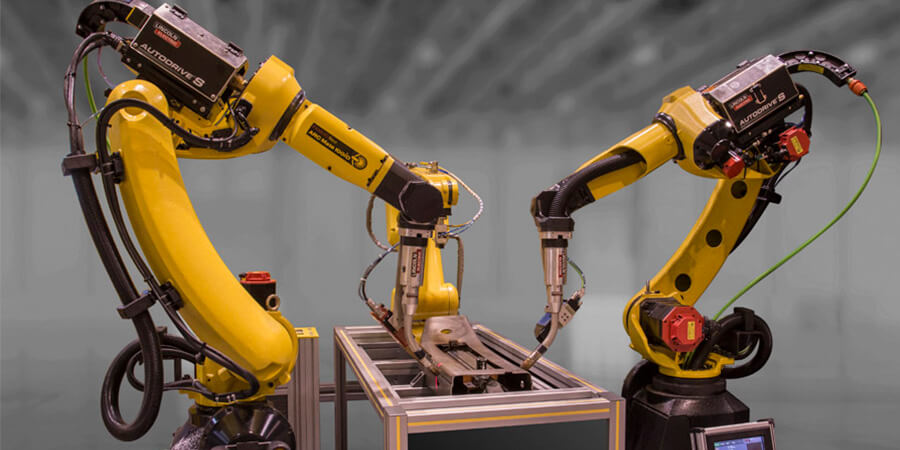
The factory floor of the 21st century is undergoing a silent revolution. Where once sparks flew solely from the visors of skilled welders, now the steady, unwavering arms of robots are increasingly taking center stage. The global welding robotics market, a critical segment of industrial automation, is experiencing robust growth, driven by an urgent need for efficiency, consistency, and the ability to navigate a complex web of economic and demographic challenges. This article explores the key drivers, trends, and future outlook of this dynamic industry.
Market Landscape and Growth Drivers
Valued at approximately USD 7-8 billion in 2024, the welding robotics market is projected to grow at a Compound Annual Growth Rate (CAGR) of 8-10% over the next five to seven years. This expansion is not incidental but a direct response to several powerful forces:
-
The Quest for Productivity and Cost-Effectiveness: Robots do not fatigue. They can operate 24/7 with consistent speed and precision, dramatically increasing output and reducing cycle times. This translates to a faster return on investment (ROI) through higher throughput and lower per-unit labor costs.
-
Addressing the Skilled Labor Shortage: Perhaps the most pressing driver is the global shortage of certified welders. An aging workforce and a skills gap are pushing manufacturers to automate to ensure production continuity and maintain capacity.
-
Uncompromising Demand for Quality and Consistency: In industries like automotive, aerospace, and heavy machinery, a single faulty weld can have catastrophic consequences. Robotic welding delivers repeatable, high-quality welds with minimal defects, reducing rework, waste, and enhancing product safety and longevity.
-
Advancements in Technology: Modern welding robots are no longer just blind, pre-programmed arms. Integration with vision systems, touch sensing, and through-arc seam tracking allows them to adapt to variations in part fit-up in real-time. This makes automation viable for smaller batch sizes and more complex applications.
Key Trends Shaping the Future
The market is evolving beyond simple automation replacement. Key trends defining its trajectory include:
-
The Rise of Collaborative Robots (Cobots): A game-changer for small and medium-sized enterprises (SMEs). Welding cobots are easier to program, can work safely alongside humans without extensive safety cages, and are more affordable. They are democratizing access to automation, bringing its benefits to job shops and low-volume, high-mix production.
-
Enhanced Ease of Use: Offline Programming (OLP) software allows engineers to program and simulate welding paths in a virtual environment, minimizing costly production downtime. Simplified teach pendants and intuitive interfaces are also lowering the barrier to entry for operators.
-
Adoption of Laser and Hybrid Welding: For applications requiring extreme speed, precision, or minimal thermal distortion, laser welding robots are gaining traction. Hybrid processes that combine laser with Gas Metal Arc Welding (GMAW) offer deep penetration and high bridgeability, opening new design possibilities.
-
Integration with Industry 4.0: Welding robots are becoming data nodes on the smart factory floor. They provide real-time data on weld parameters, wire usage, arc-on time, and predictive maintenance needs, enabling data-driven decision-making and overall equipment effectiveness (OEE) optimization.
Industry Applications: Where Robots Are Making Their Mark
-
Automotive & Transportation: The traditional stronghold, used for body-in-white assembly, chassis components, and exhaust systems.
-
Heavy Machinery & Construction: For large, often heavy components in agriculture, mining, and earth-moving equipment where weld integrity is critical.
-
Aerospace & Defense: Deployed for high-precision welding of aircraft components, engine parts, and military vehicles, often using advanced processes like TIG or laser.
-
Metal Fabrication & HVAC: A growing sector, especially with cobots, for fabricating frames, ducts, and custom metal products.
Challenges and Restraints
Despite the momentum, barriers remain. The high initial capital investment can be daunting, particularly for smaller players. Integration into existing workflows and the need for skilled personnel to program and maintain robotic cells pose challenges. Furthermore, certain complex, one-off, or highly positional welds still require the nuanced expertise of a human welder.
Regional Outlook and Competitive Landscape
Asia-Pacific dominates the market, led by China, Japan, and South Korea, fueled by massive manufacturing bases and aggressive automation policies. North America and Europe follow closely, driven by reshoring initiatives and a strong focus on advanced manufacturing and quality standards.
The market is competitive, featuring:
-
Established Industrial Robotics Giants: ABB, FANUC, Yaskawa (Motoman), and KUKA.
-
Specialist Welding Leaders: Lincoln Electric, Panasonic, and ESAB, which leverage deep welding process expertise.
-
Agile Cobot Innovators: Universal Robots (Teradyne) and others expanding the market’s reach.
Check This Regional Reports-
https://www.zionmarketresearch.com/de/report/terrazzo-flooring-market
https://www.zionmarketresearch.com/de/report/zeolite-market-size
https://www.zionmarketresearch.com/de/report/molecular-beam-epitaxy-mbe-market
https://www.zionmarketresearch.com/de/report/advanced-space-composites-market
https://www.zionmarketresearch.com/de/report/curtains-and-window-blinds-market-size
The Future Outlook: Smarter, More Adaptive, and More Accessible
The future of welding robotics is one of increasing intelligence and accessibility. We will see greater proliferation of:
-
Artificial Intelligence (AI) and Machine Learning: For self-optimizing welding parameters and true adaptive welding based on real-time sensor feedback.
-
Mobile Robotic Welding: Autonomous vehicles carrying welding robots to large, fixed structures like ship hulls or wind turbines.
-
Continued Cobot Expansion: Making robotic welding a standard tool in workshops of all sizes.
Conclusion
The welding robotics market is more than an industrial trend; it is a fundamental shift in how we build the physical world. It represents the convergence of necessity—addressing labor shortages and quality demands—with technological possibility. As robots become smarter, more collaborative, and easier to deploy, their role will transition from a luxury for large OEMs to an essential, productivity-boosting partner for the entire manufacturing ecosystem. The companies that embrace this transition will be the ones forging a stronger, more efficient, and more competitive industrial future.